
One of the main reasons players love FreeCell Solitaire is the feeling of control. Unlike Klondike or Spider, where hidden cards can ruin a perfect run, FreeCell starts with all 52 cards dealt face-up. This complete visibility raises a fascinating question: is FreeCell solitaire always winnable? The mathematical answer is remarkably close to yes, but there are a few notable exceptions that prove the rule.
Play FreeCell Solitaire Online
100% Free. Play directly in your browser in full screen mode, no download or registration required.
Play FreeCell NowThe Story of Microsoft Deal #11982
When Microsoft bundled FreeCell with Windows 95, it featured 32,000 distinct, numbered deals. The developers challenged players to win every single one. Within a few years, players successfully cleared 31,999 of them. Only a single layout remained unconquered: the legendary deal #11982.
What makes deal #11982 impossible? The card distribution creates an immediate blockade. The four Aces are buried deep at the top of the columns (the very first cards dealt), covered by high-ranking cards. Also, the cards exposed at the bottom of the columns offer no viable moves to free up space. You cannot move any card to the foundations, and you quickly run out of empty free cells trying to uncover the Aces. It is a mathematical deadlock.
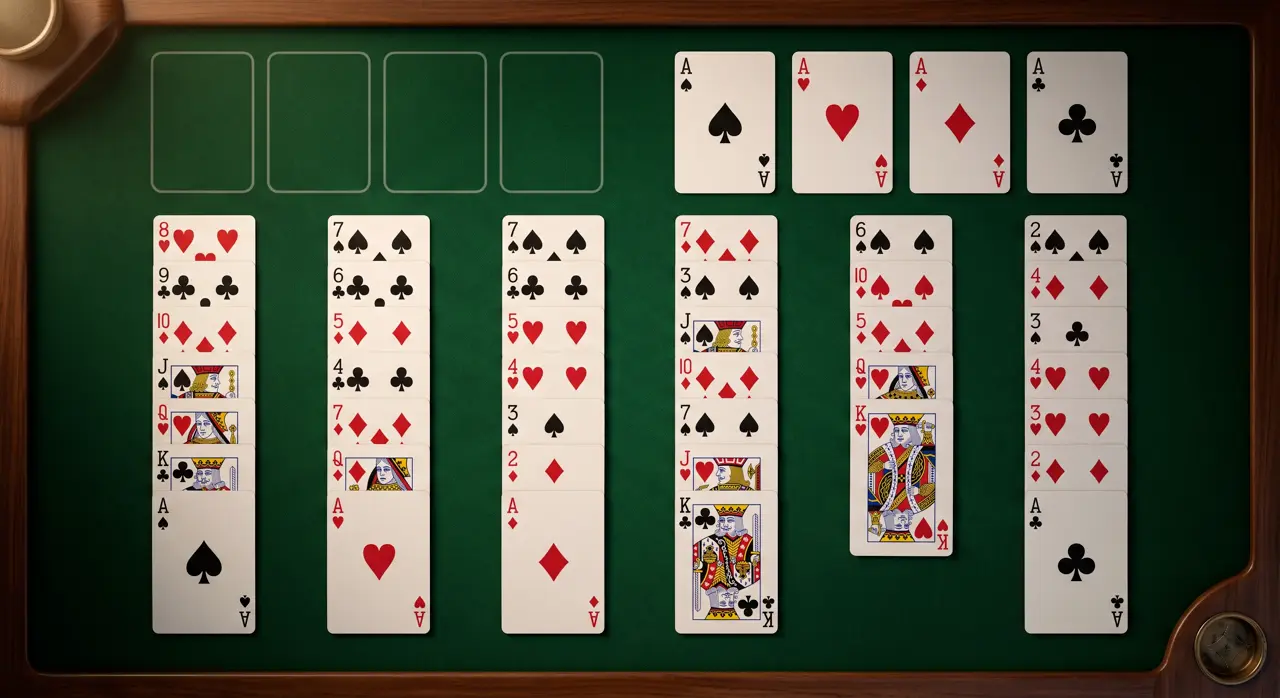
The Dave Ring Project
To confirm whether deal #11982 was truly impossible or simply required superhuman foresight, a collective effort known as the Dave Ring Project was launched in 1994. Thousands of players tried millions of different paths. Eventually, computer solvers and mathematical analysis confirmed that deal #11982 has zero winning paths.
This project marked the first time that the solitaire community systematically classified the boundaries of the game. It proved that while luck is almost entirely eliminated, the physical constraints of the deck can still construct a perfect cage.
The Million Deal Expansion
Years later, researchers extended the analysis beyond the original 32,000 layouts. Testing the first one million deals in modern software, solvers discovered that only eight deals are unsolvable.
Here are the eight impossible deals from the first million:
- Deal #11982
- Deal #146692
- Deal #186216
- Deal #455889
- Deal #495505
- Deal #512118
- Deal #539101
- Deal #750395
For any other deal in that million-game set, a solution exists. This means that if you get stuck on a standard game, the issue is almost certainly a strategic error rather than a design flaw.
What Makes a FreeCell Deal Unsolvable?
An impossible layout usually shares three defining traits:
- Buried low cards: Aces and Twos are located at the very back of the columns, meaning you must clear nearly the entire board to reach them.
- High-card blockades: The front cards in the columns are high-ranking cards of alternating colors that cannot be stacked on each other in a way that frees up columns.
- Severe space restrictions: To move a blocked card, you need an empty column or a free cell. When all columns are blocked by mismatched cards, you quickly fill all four free cells, halting the game.
How FreeCell Compares to Other Variants
FreeCell has one of the highest solvability rates among all solitaire variants. Other open-information card games share similar mechanics but have different win rates due to minor rule changes.
| Solitaire Variant | Open/Closed | Number of Free Cells | Win Rate (Perfect Play) |
|---|---|---|---|
| FreeCell | Open | 4 cells | 99.999% |
| Baker’s Game | Open | 4 cells | ~75% (Build by suit) |
| Eight Off | Open | 8 cells | ~99.8% |
| Klondike (Turn 1) | Closed | 0 cells | ~80% |
In Baker’s Game, you must build columns down in the same suit rather than alternating colors. This single rule change drops the win rate from nearly 100% to around 75%. This highlights how important the alternating color rule is for solving tight board states.
Strategic Advice: Don’t Make a Winnable Deal Impossible
Most of the games you play are winnable, but it is easy to make mistakes that lock the board. Follow these rules to keep your winning streak alive:
- Save your free cells: Treat the four free cells as temporary stepping stones. If you fill all four cells with cards you cannot play, you limit your ability to shift card sequences.
- Prioritize empty columns: An empty column is twice as useful as a free cell because it can hold a sequence of cards.
- Locate the low cards early: Before making your first move, look at where the Aces and Twos are. Make a plan to release them as quickly as possible.
- Double-check before clearing columns: Moving a card to clear a column is only useful if you have a King to place in it or if it lets you move a large sequence.