
One of the main reasons players love FreeCell Solitaire is the feeling of control. Unlike Klondike or Spider, where hidden cards can ruin a perfect run, FreeCell starts with all 52 cards dealt face-up. This complete visibility raises a fascinating question: is FreeCell solitaire always winnable? The mathematical answer is remarkably close to yes, but there are a few notable exceptions that prove the rule.
Play FreeCell Solitaire Online
100% Free. Play directly in your browser in full screen mode, no download or registration required.
Play FreeCell NowThe Mathematical Solvability of FreeCell
Unlike standard solitaire variants, FreeCell is a game of open information. Because you can see every card from the first second, luck is minimized, and your planning takes center stage.
Mathematicians and programmers have analyzed millions of deals to determine the game’s exact solvability limit. The consensus is that 99.999% of all FreeCell deals are solvable.
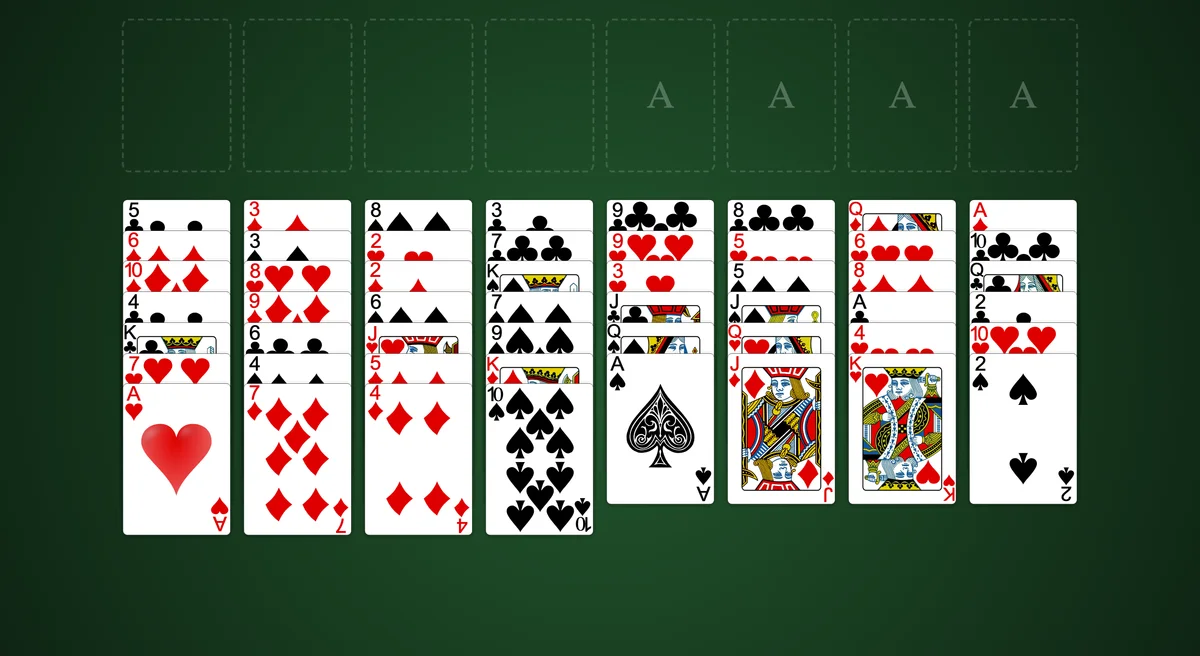
Out of the classic 32,000 deals included in the original Microsoft FreeCell game, only a single layout was proven to be impossible to beat: the infamous deal #11982.
The Infamous Unsolvable Deals
When Microsoft released its card pack in the 1990s, players began attempting to solve every deal. Soon, a collective effort known as the Dave Ring Project focused on finding any unsolvable deals. Players eventually proved that deal #11982 was the only impossible one in the initial 32,000 set.
Years later, researchers expanded this test to the first one million deals. They discovered that out of 1,000,000 games, only eight deals are unsolvable.
Here is the list of those eight impossible deals:
- Deal #11982
- Deal #146692
- Deal #186216
- Deal #455889
- Deal #495505
- Deal #512118
- Deal #539101
- Deal #750395
For any other deal in that million-game set, a solution exists. This means that if you get stuck on a standard game, the issue is almost certainly a strategic error rather than a design flaw.
How Free Cells Impact Your Odds
The four open temporary storage areas—the free cells—are the engine of the game’s high win rate. They allow you to temporarily store blocking cards and restructure your columns. However, the number of open cells directly dictates how many cards you can move in a single sequence.
Here is a quick look at how the number of empty free cells affects your move capacity:
| Empty Free Cells | Sequence Move Limit (Standard) | Sequence Move Limit (With 1 Empty Column) |
|---|---|---|
| 4 Cells | 5 cards | 10 cards |
| 3 Cells | 4 cards | 8 cards |
| 2 Cells | 3 cards | 6 cards |
| 1 Cell | 2 cards | 4 cards |
| 0 Cells | 1 card | 2 cards |
Filling up your free cells too early is the most common way to get blocked. Keep at least two cells open whenever possible to maintain your flexibility.
Key Tactics to Maintain a 100% Win Rate
If you want to achieve perfect results on winnable deals, follow these tactical rules:
- Plan Your Opening Moves: Do not start moving cards immediately. Examine the entire layout, look for the Aces, and trace a path to release them.
- Keep Cells Empty: Use the free cells only as temporary stepping stones, not permanent parking spaces. Clear them as soon as you can.
- Create Empty Columns: An empty tableau column is even more powerful than a free cell. It allows you to move entire sequences of cards, not just single cards.
- Build in Alternate Colors: Make sure you plan your tableau piles to alternate between red and black. Building a single-color column will quickly lead to a dead end.