
Pyramid Solitaire is a unique and challenging variation of the classic card game. Its distinct triangular setup and simple card-pairing math make it incredibly fast to play. However, if you have spent any time playing it, you have likely noticed how frequently you run out of moves. This leads to a common question: what are your actual pyramid solitaire odds of winning? The mathematical reality is that Pyramid is one of the hardest solitaire games to clear, but your choice of rules determines your chances.
Play Pyramid Solitaire Online
100% Free. Play directly in your browser in full screen mode, no download or registration required.
Play Pyramid NowUnderstanding the Pyramid Solitaire Layout and Rules
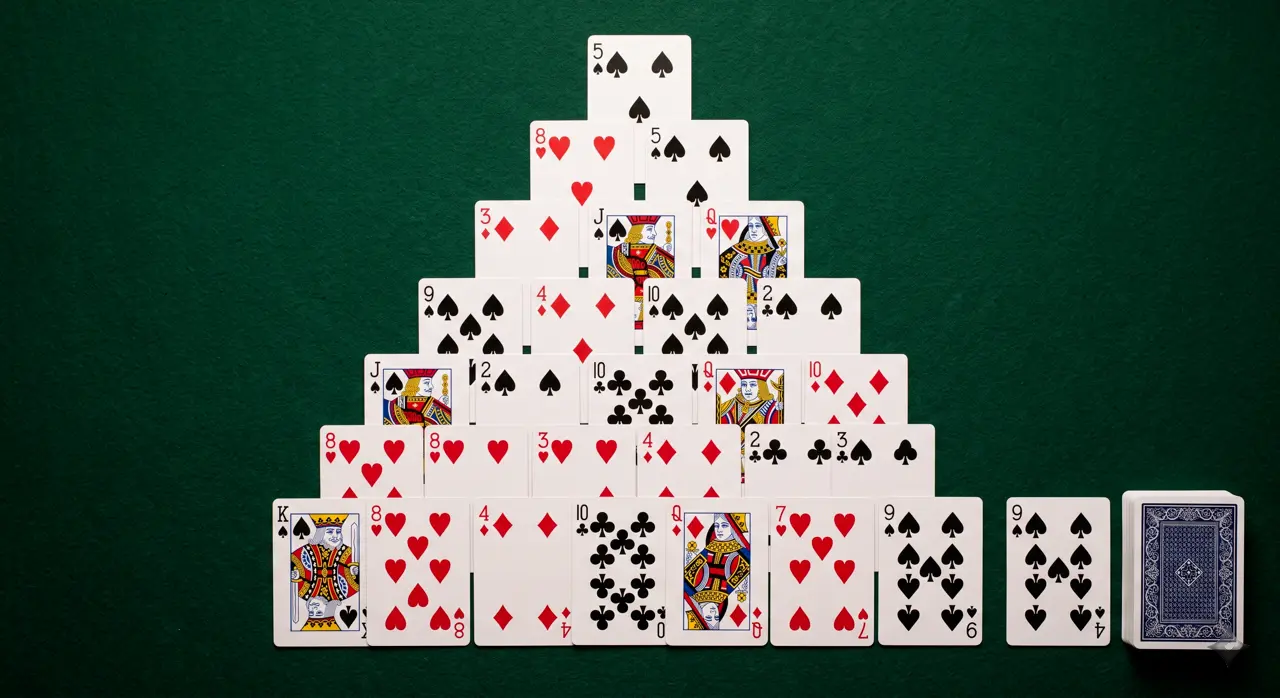
To understand the mathematical blockages, we must first look at the layout. A standard deck of 52 cards is divided into two areas:
- The Pyramid: 28 cards dealt face-up in a triangular shape consisting of seven rows. The top row has one card, the second has two, and so on, down to the seventh row which has seven cards.
- The Stock Pile: The remaining 24 cards are kept face-down in a pile at the bottom.
You play by removing pairs of cards that add up to exactly 13. Aces are worth 1, Jacks are 11, Queens are 12, and Kings are 13 (which can be discarded individually). Only cards that are completely uncovered in the pyramid—meaning no cards overlap them from the row below—are active and eligible for pairing.
The Mathematical Odds of Winnability
Pyramid Solitaire is a game of restricted space. With only 24 cards in the stock pile to help clear 28 cards in the pyramid, the mathematical win rate is naturally low.
According to computer simulations, the win percentage shifts drastically depending on the rules of the stock pile:
- Strict Rules (1 Stock Pass): If you are only allowed to run through the stock pile once, and you can only pair a card from the stock with a card in the pyramid, your odds of winning are only about 1% to 2%. This means you will win only one or two games out of a hundred.
- Standard Rules (3 Stock Passes): Under standard online play where you can pass through the stock pile three times, the win rate increases to between 15% and 20%.
- Relaxed Rules (Unlimited Stock Passes): If you play with unlimited runs through the stock pile and allow pairing stock cards with other stock cards, the win rate jumps to nearly 30%.
| Rule Set | Passes Through Stock | Stock-to-Stock Pairing | Human Win Rate |
|---|---|---|---|
| Strict Rules | 1 Pass | No | ~1.5% |
| Standard Rules | 3 Passes | No | ~18% |
| Relaxed Rules | Unlimited | Yes | ~30% |
Why Do So Many Pyramid Layouts Get Blocked?
The primary reason for a dead end is a card blockade. Because the pyramid cards overlap, a lower card is often blocked by a higher card.
For example, if you need to pair a 6 with a 7 to clear the third row, but all four 7s in the deck are located in the rows underneath that 6, the game is mathematically unsolvable from the start. You cannot reach the 7s because they are covered, and you cannot clear the 6 because you have no 7s to pair it with. This structural blockade occurs in a large portion of random deals.
Tactical Tips to Boost Your Pyramid Win Rate
While the math is tough, you can improve your chances by using these rules on how to win pyramid solitaire:
- Scan the Pyramid Before Playing: Before you make your first pair, look at the distribution. Check if any card is blocked by its only matching pairs. If you see a 5 buried under all four 8s, you know the deal is unsolvable and you can restart immediately.
- Prioritize Pyramid Cards: Always pair cards that are both located within the pyramid before using cards from the stock pile. Clearing the pyramid is your only goal; clearing the stock pile does not win the game.
- Expose Covered Cards Evenly: Do not focus on clearing one side of the pyramid while leaving the other side full. Work to expose cards across all columns to maximize your options.
- Leave Kings for Later: Since Kings can be removed individually, they never require a matching partner. Do not rush to remove a King from the board unless it is directly blocking another card you need.