
In a world filled with constant notifications and high-stress digital distractions, finding a simple way to unwind is essential. While many view solitaire as a simple pastime, the mental benefits of playing solitaire are well-documented. A daily session of this classic card game—often known simply as patience in the UK—can act as a mental reset button, helping to calm your nervous system while keeping your cognitive skills sharp.
Understanding the psychological effects of this century-old pastime will show you why the benefits of solitaire game sessions make it a valuable tool for mental wellness.
Play Daily Solitaire
100% Free. Play solitaire patience online free directly in your browser in full-screen mode, no download or registration required.
Play Game NowThe Core Mental Benefits
Playing a quick game of solitaire daily affects your brain in several positive ways. Here is a summary of the primary benefits:
| Mental Area | Benefit | How Solitaire Helps |
|---|---|---|
| Stress Reduction | Calms the mind | Triggers a light, meditative “flow state” that lowers anxiety |
| Cognitive Exercise | Keeps brain active | Promotes mild problem-solving, memory recall, and planning |
| Focus and Concentration | Sharpens attention | Requires focus on card sorting, block identification, and sequences |
| Patience Training | Builds emotional control | Teaches acceptance of unsolvable deals and encourages strategic delay |
| Screen-Time Transition | Relaxing routine | Replaces stressful social media feeds with a structured, low-stakes task |
A Low-Stakes Meditative Flow State
One of the greatest benefits of solitaire is its ability to induce a state of flow. Flow is a psychological state where you are fully immersed in an activity, blocking out external worries.
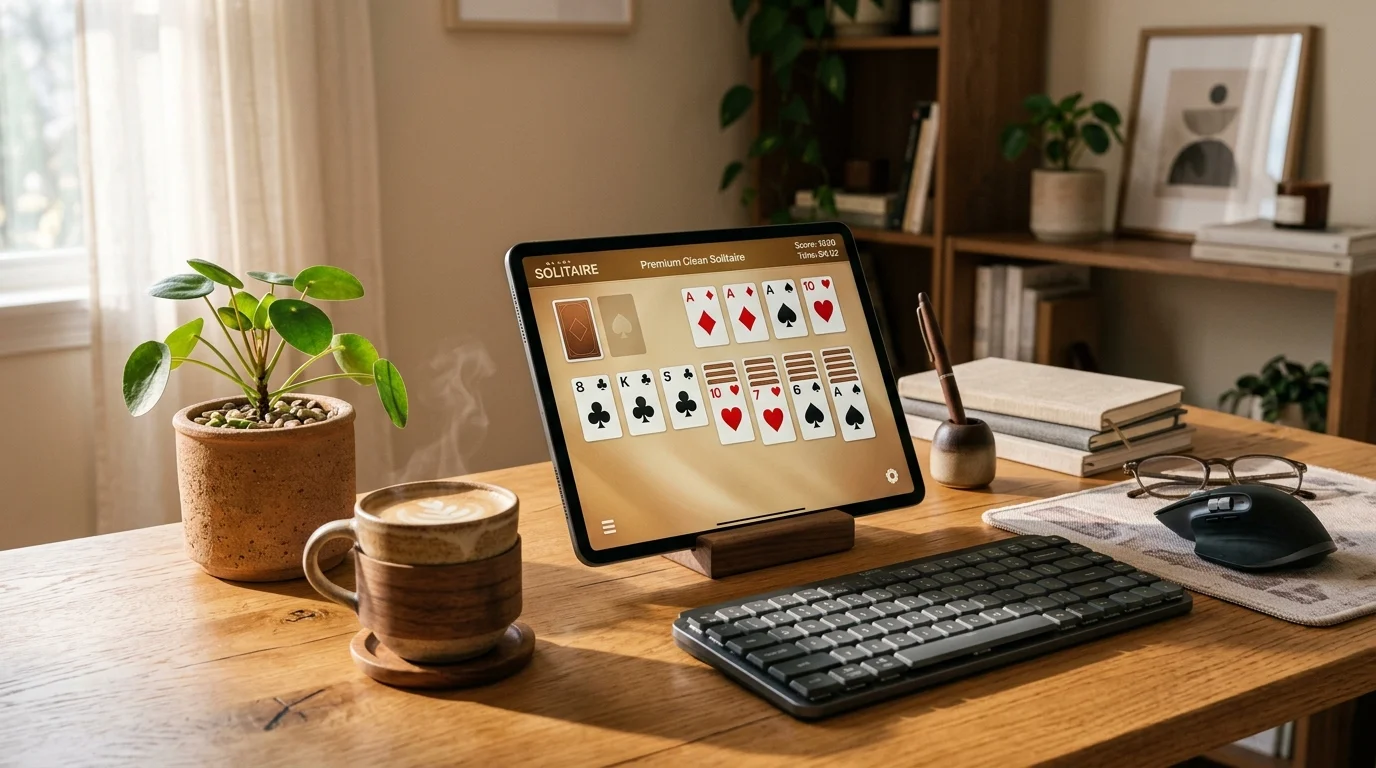
Unlike complex strategy video games that require quick reflexes and trigger adrenaline spikes, solitaire is played at your own pace. There are no ticking clocks or flashing alarms unless you choose to use them. The simple, repetitive action of sorting cards allows your brain to relax, easing the sympathetic nervous system (your fight-or-flight response). Many players find that a 10-minute session of daily patience before bed or during a lunch break acts as a form of active meditation.
Mild Cognitive Conditioning
While solitaire relaxes the emotional centre of your brain, it also gives your prefrontal cortex—the area responsible for decision-making and planning—a light workout.
When playing classic Klondike or FreeCell, you must continuously hold information in your memory:
- Visual Pattern Matching: You scan the tableau to identify card numbers and suit patterns.
- Sequencing Decisions: You weigh choices, such as deciding whether to move a card to a column or wait for a better layout.
- Working Memory: In games like Turn 3 Solitaire, you track the order of cards in the stock pile to manipulate their future groupings.
This mild mental effort keeps your brain active without causing cognitive fatigue, making it an excellent daily habit for individuals of all ages.
Building Patience and Acceptance
Solitaire is a game where you cannot win every deal. Some deals are mathematically impossible to solve.
Playing regularly teaches you to accept situations outside your control. When you run into an unsolvable board, you learn to hit the reset button and start fresh without frustration. For deals that are winnable, the game rewards patience. This direct link between mental composure and success is why the game is traditionally called patience in the UK. When comparing patience vs solitaire, the rules are identical, but playing solitaire patience online free or on a physical table serves as a wonderful exercise in self-control. Rushing to stack cards too quickly often leads to self-inflicted blocks. You learn the value of pausing, looking at the entire board, and planning before taking action.
Making Solitaire a Daily Wellness Habit
To get the most out of your solitaire sessions, try treating them as a mindful routine:
- Avoid multitasking: Turn off notifications and focus entirely on the cards.
- Keep it brief: A single 10-to-15 minute session is enough to clear your mind.
- Choose the right variant: If you want relaxation, play Turn 1 Solitaire. If you want a deeper strategic puzzle, try FreeCell or Yukon.