
Winning Spider Solitaire with only a single suit is highly achievable, but doing it consistently requires discipline. Unlike the multi-suit versions where colour and suit mismatches block your moves, the one-suit variation uses 104 cards that all belong to the same suit—typically Spades. Because every card matches, any sequence you build can be moved together.
This makes the game highly winnable, with a statistical win rate of nearly 99% for players who plan their moves carefully.
Play Spider Solitaire 1 Suit
100% Free. Play directly in your browser in full screen mode, no download or registration required.
Play Game NowUnderstanding the One-Suit Layout
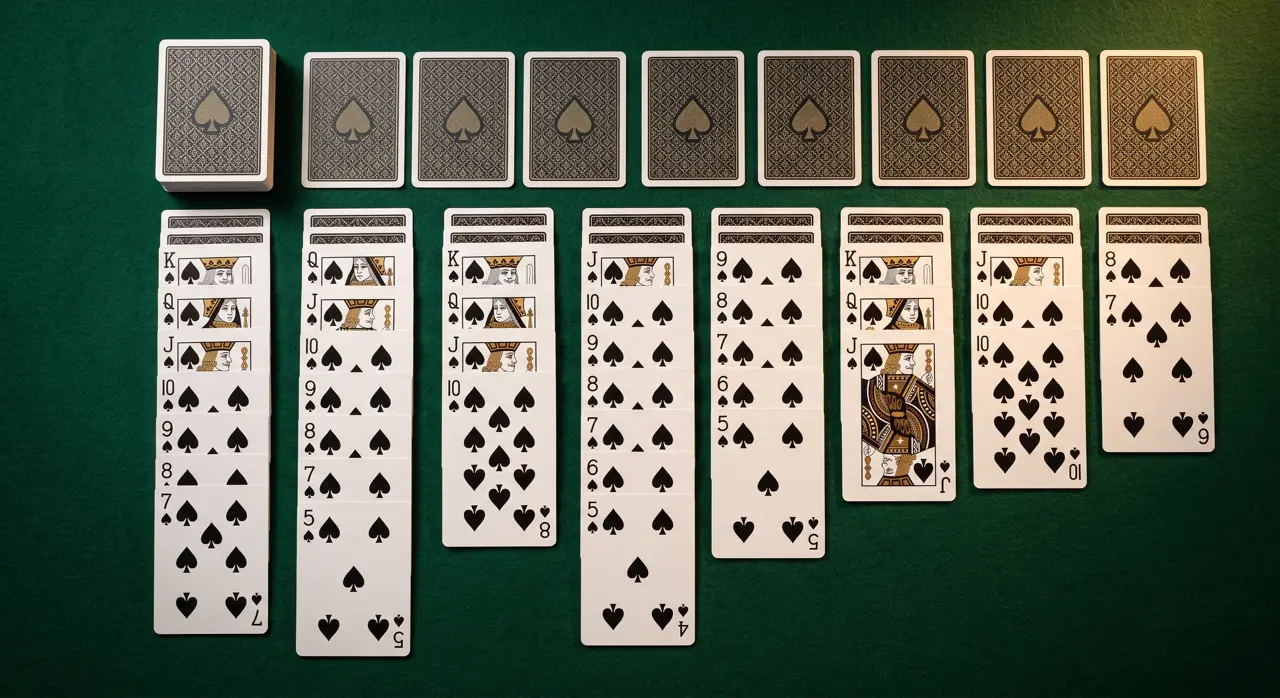
Before jumping into the strategy, it is helpful to visualise the structure of the game. Even though the rules are relaxed compared to four-suit games, the card distribution remains the same.
| Game Aspect | Setup Specification |
|---|---|
| Total Decks | 2 standard decks (104 cards total) |
| Active Suit | 1 suit (all Spades) |
| Initial Tableau | 54 cards dealt across 10 columns |
| Stock Pile | 50 cards remaining for drawing rounds |
| Stock Deals | 5 rounds (each dealing 10 cards to the tableau) |
Because all cards are Spades, you never have to worry about colour coordination. Your sole objective is to build complete columns from King down to Ace, which are then immediately cleared from the board.
Core Strategy to Win Every Hand
Since the mechanics are simplified, your main opponents are impatience and bad column management. Follow these tactics to secure a win on almost every single deal.
1. Prioritise Uncovering Hidden Cards
At the start of the game, 44 cards are face-down underneath your active columns. Your primary goal is to expose these hidden cards. When faced with multiple choices, always move cards from columns that have the most face-down cards underneath. Exposing these cards expands your options and prevents you from running out of moves.
2. Create and Protect Empty Columns
An empty column is your most valuable asset. It allows you to shift cards around freely to expose blocked cards. In one-suit play, getting an empty column is relatively easy.
Once you clear a column, do not rush to fill it with a random card. Use it as a temporary sorting station to unpack other columns and build clean sequences.
3. Expose Kings Only When Safe
Kings are the highest-ranking cards and cannot be placed on top of any other card. If you move a King into an empty column, that column becomes partially blocked until you build a complete sequence down to the Ace. Only place a King in an empty column if you have enough active cards to build a significant portion of that sequence immediately.
4. Build Organised Sequences
Even though you can move any sequence of Spades, it is best to keep your columns as organised as possible. Avoid creating random, scattered piles. Try to build long, unbroken sequences in descending order (e.g., 10, 9, 8, 7). This makes it easier to manage the board and clear entire columns in one clean action.
5. Clear Columns Before Dealing
Dealing a new row of cards from the stock pile adds one card to each of the 10 columns. This will bury your active sequences and fill any empty spaces you worked hard to create.
Always exhaust every possible move on the board before clicking the stock pile. If you have an empty column, try to use it to rearrange cards before drawing, but remember that you must fill all empty columns with at least one card before the game allows you to deal from the stock pile.