
Winning a game of Spider Solitaire with all four suits is one of the hardest accomplishments in card gaming. While single-suit and two-suit variants offer relaxed, strategic fun, adding Spades, Hearts, Diamonds, and Clubs into a double-deck layout creates a massive math puzzle where blockers appear at almost every turn.
To beat this game consistently, you need to understand the statistical reality of the cards and adjust your tactics accordingly.
Play Spider Solitaire 4 Suits
100% Free. Play directly in your browser in full screen mode, no download or registration required.
Play Game NowThe Statistical Reality of Four Suits
Unlike FreeCell where almost every deal is winnable, Spider Solitaire 4 Suits has a low natural win rate. For an average player making standard decisions, the win rate hovers between 6% and 15% on random deals without using undo.
However, computer simulations show that perfect play and unlimited undo operations allow skilled players to win between 30% and 50% of games. Some elite players maintain win rates above 80% by carefully backtracking through wrong turns to find hidden paths.
This gap shows that player skill and decision-making matter far more than the luck of the deal.
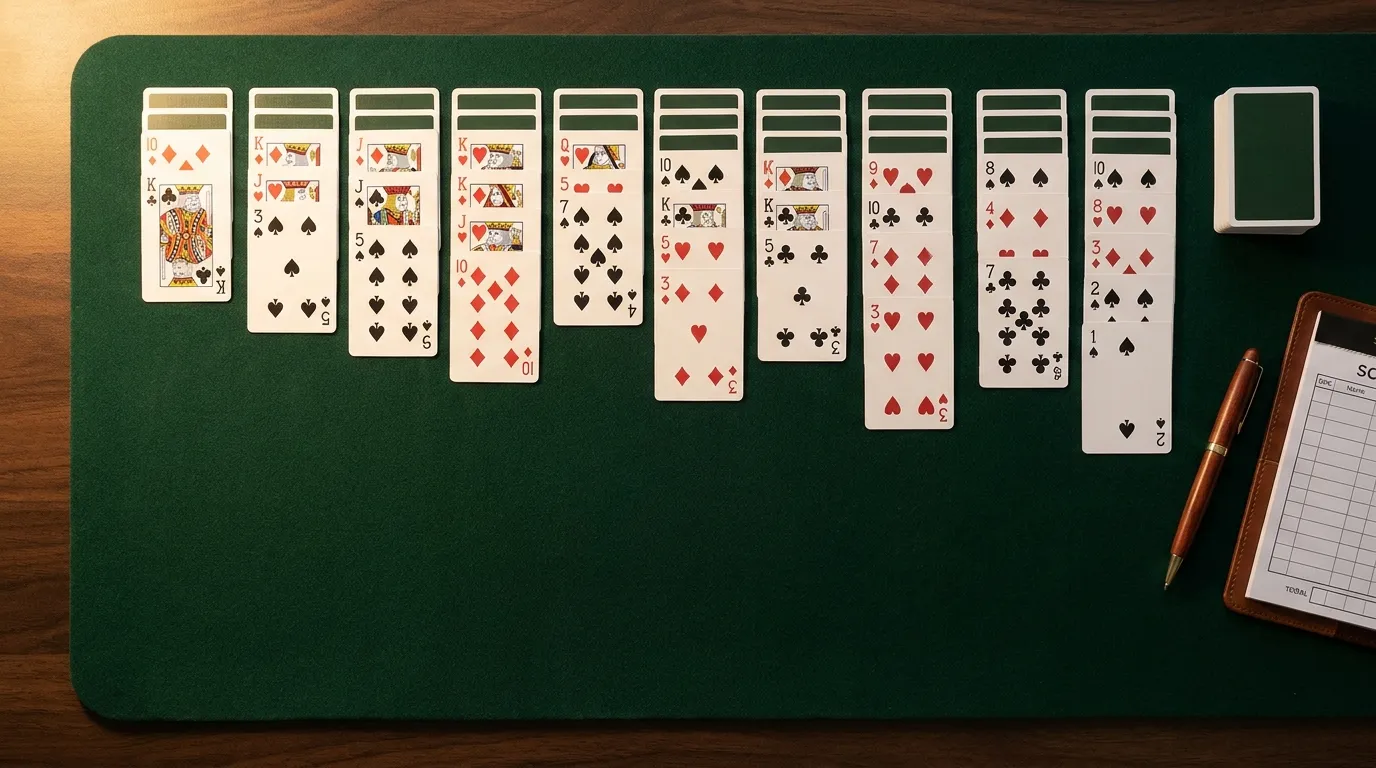
Why Four Suits is a Mathematical Nightmare
The immense difficulty of the four-suit version stems from the sheer scale of the card layout and the strict rules governing card movement.
- Two Full Decks (104 Cards): 54 cards are dealt at the start across 10 columns, leaving 50 cards in the stock pile to be drawn later.
- The Suit Matching Constraint: You can build downward sequences regardless of suit. However, you can only move columns of cards as a unit if they are all of the identical suit.
- The Clearing Requirement: To remove a run of cards from the board, you must assemble a full sequence from King down to Ace in the exact same suit.
Because you must build across suits to expose face-down cards, you will constantly create mixed columns that cannot be moved together. These mixed columns block your board, limit your flexibility, and make it easy to get stuck.
Comparing Spider Solitaire Variations
Removing suits drastically changes the odds of winning.
| Variant | Decks Used | Suits Included | Est. Win Rate (No Undo) | Est. Win Rate (With Undo) | Difficulty |
|---|---|---|---|---|---|
| Spider 1 Suit | 2 | 1 (Spades) | 90% - 99% | 99% - 100% | Very Easy |
| Spider 2 Suits | 2 | 2 (Spades/Hearts) | 30% - 50% | 80% - 90% | Medium |
| Spider 4 Suits | 2 | 4 (All suits) | 6% - 15% | 30% - 50% | Insane |
Actionable Strategy to Improve Your Winning Odds
While the cards are stacked against you, following a strict set of strategic rules can help double your success rate.
1. Build in Same Suits Whenever Possible
Always prefer placing a card on another of the same suit. Even if a cross-suit move looks convenient, it creates a split column that cannot be moved together. Keep your sequences clean as long as you can to preserve your movement options.
2. Prioritise Empty Columns
An empty tableau column is your most powerful tool. It serves as a temporary space to separate mixed columns and group cards of the same suit together. Never leave a column empty if you can use it to clean up other piles first, but always try to secure at least one open space before dealing from the stock pile.
3. Expose Hidden Cards in Shallow Columns
When deciding which column to clear, target the columns with the fewest hidden cards first. Clearing these columns quickly yields empty spaces, which gives you the manoeuvrability needed to tackle deeper piles.
4. Delay Dealing from the Stock Pile
Dealing a new row of cards from the stock pile puts one card on every column, burying your organised sequences and filling your empty columns. Only click the stock pile when you have exhausted every single legal move on the board.