
Many players searching for card games online wonder about the difference between Classic Solitaire and Klondike. You open one app and see ‘Solitaire,’ then open another and find ‘Klondike.’
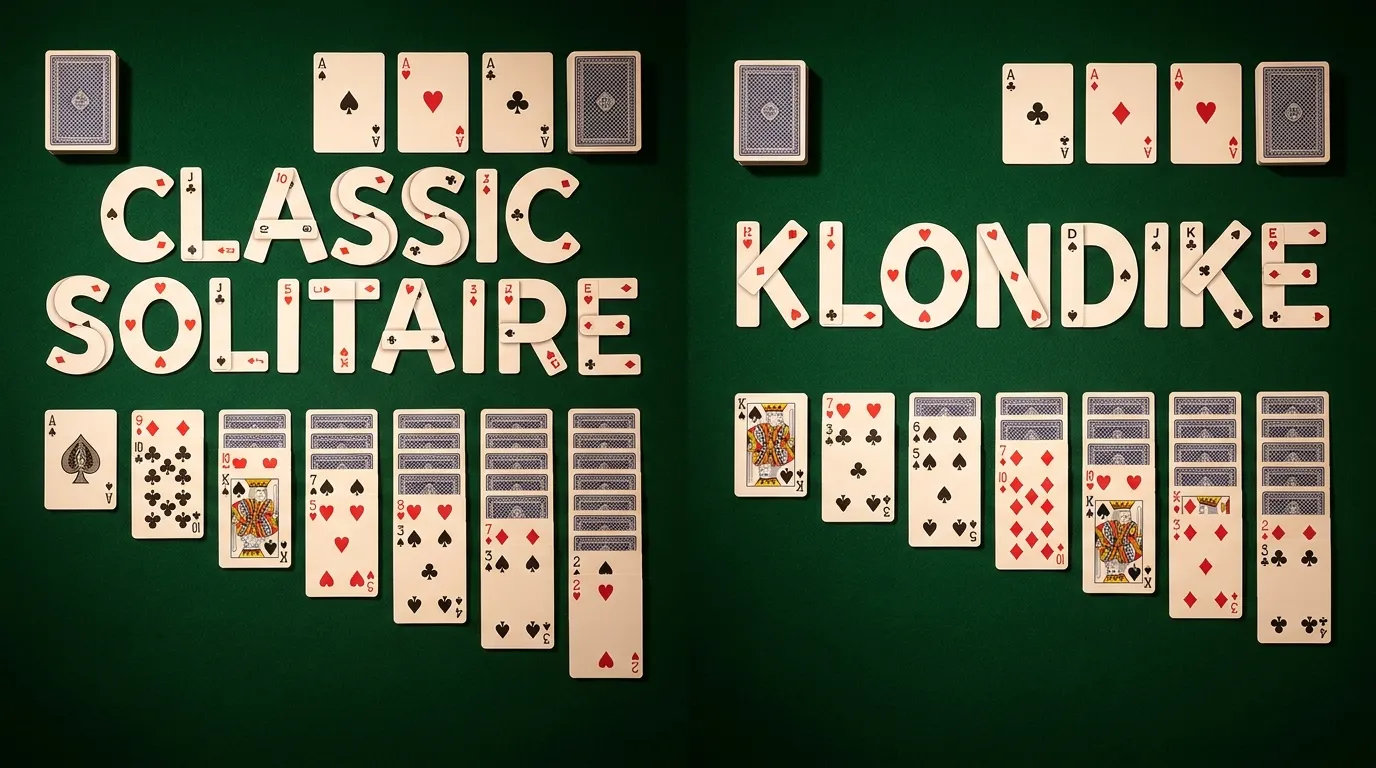
The short answer is simple: Classic Solitaire and Klondike are the exact same game.
Understanding how these terms became interchangeable, their historical origins, and where they sit in the wider card game family can help clarify the naming confusion.
Play Classic Solitaire
100% Free. Play directly in your browser in full screen mode, no download or registration required.
Play Game NowClassifying the Card Games
To understand why we have two names for the same game, it helps to look at the hierarchy of single-player card games.
| Naming Term | Scope & Definition | Game Examples |
|---|---|---|
| Solitaire (Patience) | The broad category of all single-player card puzzles | FreeCell, Spider, Pyramid, Yukon, TriPeaks |
| Classic Solitaire | The popular name for the standard 7-column game | Draw 1 Solitaire, Draw 3 Solitaire |
| Klondike | The official, historical name of the classic game | Klondike Turn 1, Klondike Turn 3 |
‘Solitaire’ (referred to as ‘Patience’ in the UK and Europe) is the umbrella term for hundreds of distinct games. Saying ‘I am playing Solitaire’ is like saying ‘I am playing a board game.’
Klondike is one specific variation within that family. However, because Klondike is the most popular variation in the world, people began calling it simply ‘Solitaire’ or ‘Classic Solitaire.‘
The Origin of the Naming Confusion
The division between these two names comes down to two major historical events: a gold rush and a software bundle.
The Klondike Gold Rush
The game got its official name in the late 1890s during the Klondike Gold Rush in Yukon, Canada. Prospectors seeking gold played the game to pass time during the harsh, freezing winters. When they returned home, they brought the game with them, calling it ‘Klondike’ after the region where they played it.
The Microsoft Windows Influence
In 1990, Microsoft decided to include a free card game with Windows 3.0. The game they chose was Klondike. However, instead of naming the application ‘Klondike,’ they labeled it simply as ‘Solitaire.’
Since hundreds of millions of people learned the game on Windows PCs, they associated the word ‘Solitaire’ exclusively with Klondike. When other variations like FreeCell and Spider were introduced in later Windows updates, they were given their specific names, leaving Klondike to claim the generic title of ‘Solitaire’ in the minds of the public.
Core Rules of the Classic Game
Whether you call it Klondike or Classic Solitaire, the game uses a standard set of rules:
- The Setup: A single 52-card deck is dealt into seven columns. The first column has one card, the second has two, and so on, leaving 24 cards in the stockpile.
- The Goal: Build four foundation piles from Ace up to King, separated by suit.
- The Tableau Rules: Move cards between columns in descending order and alternating colors (e.g., placing a red 7 on a black 8).
- The Stockpile: Draw either one card (Turn 1) or three cards (Turn 3) from the stockpile when you run out of moves on the board.