
When people say “Solitaire,” they almost always mean classic Klondike. While Yukon Solitaire shares the same visual layout, it plays like a completely different game. The absence of a draw pile and the freedom to move unsorted stacks of cards turn Yukon into an open strategic puzzle, whereas Klondike remains a game of slow discovery.
Knowing how the core mechanics differ will help you pick the right card game for your skill level.
Play Yukon Solitaire
100% Free. Play directly in your browser in full screen mode, no download or registration required.
Play Game NowComparing Rules and Board Setups
At first glance, both boards look identical. Both feature seven columns and four foundation piles. However, the card distribution and movement rules differ:
| Game Mechanic | Classic Klondike Solitaire | Yukon Solitaire |
|---|---|---|
| Deck Layout | 28 cards on tableau, 24 in stock | All 52 cards on tableau |
| Stock Pile / Waste Pile | Yes (Draw 1 or Draw 3 cards) | None |
| Stacking Rules | Alternating colors descending | Alternating colors descending |
| Group Card Movements | Only perfectly sorted sequences | Any face-up card and all cards on top of it |
| Empty Columns | Kings only | Kings only |
| Average Win Rate | ~30% (Turn 3) to ~80% (Turn 1) | ~30% with smart play |
Classic Solitaire starts with only 28 cards on the board, leaving the rest in the stock pile. You must stack cards in alternating colors, and you can only move a group of cards if they are already in a clean, descending sequence.
Yukon deals all 52 cards onto the board at the start, with no stockpile. While you still stack cards in alternating colors, you do not need a clean sequence to move a card. You can pick up any face-up card and place it on a valid landing card in another column, taking the entire unsorted stack resting on top along for the ride.
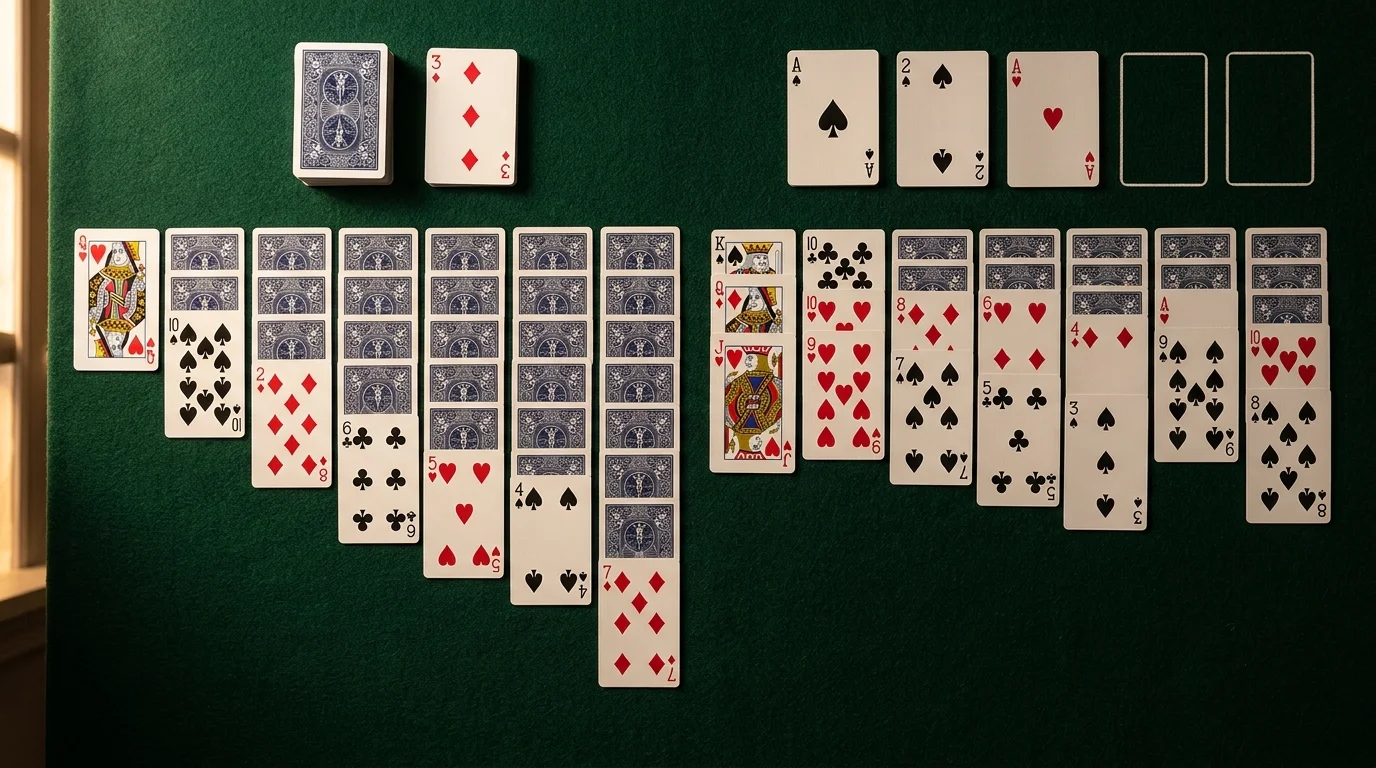
Klondike: The Draw-Pile Discovery Game
Klondike relies on hidden information. Since almost half the deck sits in the stock pile, you must cycle through these cards to find what you need.
Your progress is often blocked by face-down cards in the tableau. Because you can only move clean sequences of cards, you have very little flexibility. If a red Jack is sitting on top of a black Queen and you want to move them, they must stay together. If you get stuck, you draw from the stock pile. This creates a game loop of drawing, exposing, and stacking that relies on the luck of the draw.
Yukon: The Open Grouping Challenge
Yukon removes the luck of drawing. Since every card is on the board, you have a complete picture of the deck. However, this open layout comes with a trade-off: you have no stockpile to save you.
To compensate, Yukon introduces its unique group-movement rule. You can grab a black 8 at the middle of a messy column and move it to a red 9 in another column. The three unsorted cards sitting on the black 8 move with it. This gives you incredible flexibility to clean up columns and expose the 21 face-down cards. Your primary goal is exposing these hidden cards; once they are face-up, the game is usually won.
Strategy: Adjusting Your Play
How to Play Klondike:
- Check the Tableau First: Always play cards on the board before drawing from the stock.
- Build Foundations Slowly: Leave cards on the board if they can serve as landing spots for other cards.
How to Play Yukon:
- Focus on Hidden Cards: Look for the columns with face-down cards and work to clear them.
- Keep Empty Columns Open: Do not rush to fill an empty column unless you need to park a King to expose a face-down card. Empty columns are valuable workspaces.
- Group Suits Together: Try to build sequences in the same suit on the tableau when possible to make final collection easier.