
Switching from Turn 1 to Turn 3 Solitaire changes the game from a relaxed card-shifting session into a intense logical puzzle. While the starting layout of 28 cards remains identical, drawing three cards at a time from the stock pile introduces a steep drop in win rates.
Understanding the mathematical solvability of 3 Card Solitaire can help you play more efficiently and avoid getting blocked by inaccessible cards.
Play Turn 3 Solitaire
100% Free. Play directly in your browser in full screen mode, no download or registration required.
Play Game NowThe Statistical Drop: Turn 1 vs. Turn 3
The main difference between the two variations is how cards are drawn from the stock pile. This single rule change has a massive impact on your odds of winning.
| Game Mechanic | Draw 1 Solitaire (Turn 1) | Draw 3 Solitaire (Turn 3) |
|---|---|---|
| Draw Action | 1 card per click | 3 cards per click (only top card playable) |
| Average Win Rate | 30% - 40% | 10% - 15% |
| Perfect Play Solvability | 80% - 90% | 70% - 80% |
| Difficulty Level | Easy / Relaxing | Medium / Strategic |
For casual players making standard moves, the win rate for 3 Card Solitaire hovers between 10% and 15% on random deals if you do not use the undo button. Under perfect conditions—using computer solvers with unlimited backtracking and full card visibility—the solvability rate is between 70% and 80%.
This statistical gap indicates that while most deals are technically winnable, finding the winning path is extremely difficult without planning and careful tracking.
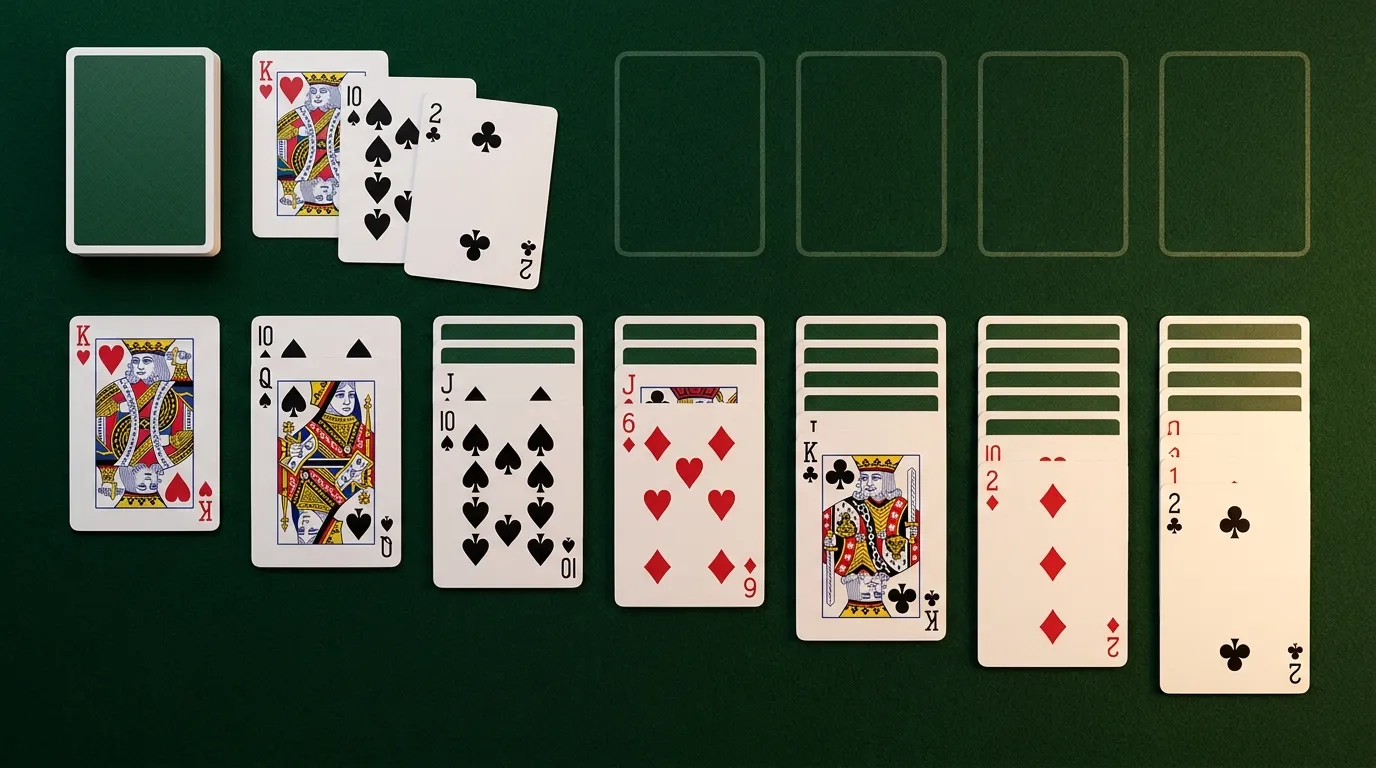
Why Triplet Deals Create Blocks
In Turn 3 Solitaire, the remaining 24 cards in the stockpile are dealt in groups of three. You can only play the top (third) card of that triplet. The two cards underneath remain completely locked.
If you cannot find a space on the tableau for that top card, the entire triplet is blocked, and you cannot access the cards below it during that pass. This grouping creates deadlocks where a card you need is permanently buried behind a card you cannot move.
Strategic Rules to Beat Draw 3 Solitaire
To beat the odds and win more Turn 3 games, you must change how you manage the board:
1. Shift the Card Order (The Rule of Three)
Every time you play a card from the waste pile, you change the order in which cards are drawn on your next pass through the deck. For example, if you have a triplet of Jack, 9, and 2, playing the Jack shifts the alignment of the remaining stockpile cards by one on the next pass. Use this to reveal cards that were previously locked underneath.
2. Prioritise Tableau Moves
Always make moves within the seven tableau columns before drawing cards from the stock pile. Shifting cards on the board uncovers face-down cards without adding new blocks to your waste pile.
3. Save Cards on the Tableau
Avoid sending cards to the foundation piles too quickly. While it feels satisfying to clear Aces and Deuces, keeping mid-range cards (4s, 5s, 6s) on the tableau gives you more places to play cards drawn from the stock pile. Retaining these cards on the board is key to unlocking your waste pile.
4. Create Empty Columns Only for Kings
An empty column can only be filled by a King. If you clear a column but do not have a King ready to fill it, you lose that space. Keep columns occupied until you can place a King, which can then support a long sequence of cards.