
Klondike and Yukon Solitaire share the same basic layout and the goal of moving cards to the foundations. However, the similarities end there. Yukon takes the traditional Klondike formula and removes the comfort of the stockpile, while giving you complete freedom to move piles of unsorted cards around the board.
Understanding how these rules change the flow of play will improve your strategy and help you decide which variant to play next.
Play Yukon Solitaire
100% Free. Play directly in your browser in full screen mode, no download or registration required.
Play Game NowComparing the Rules and Layouts
Both games deal cards into seven columns, but the way they distribute the deck and allow card movements creates two distinct playing experiences.
| Game Mechanic | Klondike Solitaire | Yukon Solitaire |
|---|---|---|
| Deck Size | 1 deck (52 cards) | 1 deck (52 cards) |
| Initial Tableau Cards | 28 cards (21 face-down) | 52 cards (21 face-down) |
| Stockpile / Waste | Yes (24 cards) | None |
| Stacking Rules | Alternating colors (Red on Black) | Alternating colors (Red on Black) |
| Moving Card Blocks | Only fully sorted sequences | Any face-up card and all cards on it |
| Empty Column Rules | Kings only | Kings only |
| Estimated Win Rate | ~30% (Draw 3) to ~80% (Draw 1) | ~30% (Skilled play) |
In Klondike, you only deal 28 cards onto the tableau. The remaining 24 cards sit in a stockpile, which you draw from when you get stuck. You can only move card stacks if they are already in a perfect, alternating-color sequence.
Yukon deals all 52 cards onto the tableau at the start. Since there is no stockpile, you must work entirely with what you see on the board. Yukon’s signature rule is the freedom of movement. You can grab any face-up card in a column and move it, along with every card stacked on top of it, regardless of their order.
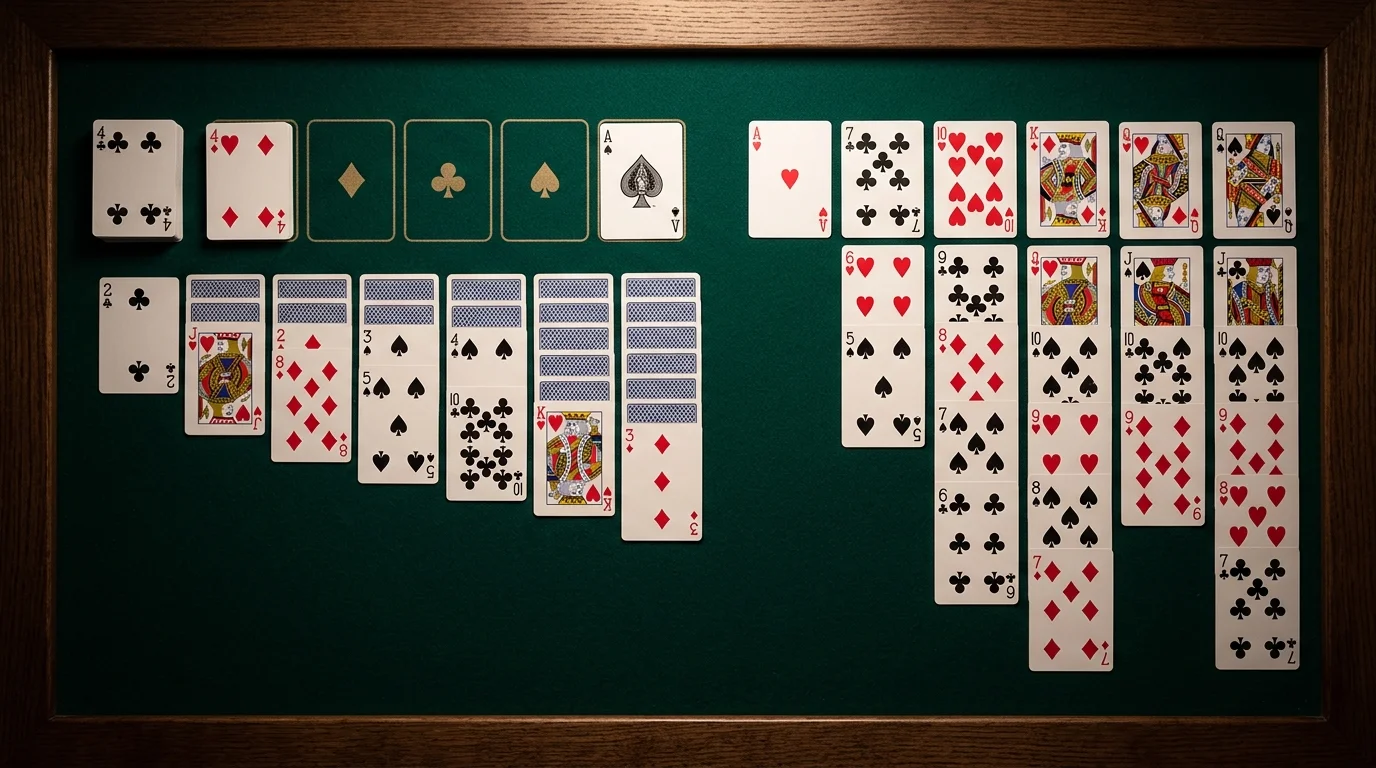
Why Klondike is the Balanced Classic
Klondike relies on a slow reveal. You deal with a limited board at first, and your success depends on how you manage the stockpile.
Because you can only move clean, sequential stacks of cards on the tableau, you often run into blocks where a needed card is trapped under an unsorted column. This forces you to constantly draw cards from the waste pile, looking for ways to break the lock. Klondike offers a comfortable, structured pace where drawing cards acts as a safety valve.
Why Yukon is a High-Skill Puzzle
Yukon is a completely open puzzle. Because all 52 cards are on the board from the beginning, you have access to everything, but you also start with a massive, messy board.
Since you have no stockpile to rescue you, a single mistake can quickly make the game unwinnable. However, Yukon gives you a powerful tool: the ability to move unsorted piles. For example, if you have a red 6 at the bottom of a messy column with three random cards resting on top of it, you can move the entire group and rest the red 6 onto a black 7 in another column.
This rule turns Yukon into a game of card grouping. Your main challenge is finding and exposing the 21 face-down cards. Once you flip all the hidden cards, winning becomes a simple task of clean-up.
Strategic Tips for Both Games
In Klondike:
- Empty Columns Wisely: Do not clear a column unless you have a King ready to move into it. An empty column is useless if it sits empty.
- Keep Stockpile Cards in Play: Avoid building too fast from the stock pile to the foundations. You might need those cards as landing spots for tableau cards later.
In Yukon:
- Expose Hidden Cards First: Focus your moves on columns with the most face-down cards. The faster you expose these cards, the sooner you find the keys to unlock your board.
- Build Suit Runs Early: Since you can move unsorted stacks, try to organize cards by suit within alternating runs to make eventual foundation collection faster.
- Free the Kings: You need empty columns to parking Kings that block face-down cards. Plan your columns to free up space.