
If you find standard solitaire variations too easy, Yukon and Russian Solitaire represent the ultimate tests of card strategy. Both games deal all 52 cards onto the board at setup and use the same open-movement rules where you can grab any face-up card. Yet, one simple change to the stacking rules turns Russian Solitaire into one of the most punishing card games ever created.
Understanding the difference in rules and difficulty will help you prepare for these intense solitaire variants.
Play Russian Solitaire
100% Free. Play directly in your browser in full screen mode, no download or registration required.
Play Game NowStacking and Movement Rules Comparison
While both boards use 52 cards across seven columns with no stockpile, the stacking mechanics set them apart:
| Game Mechanic | Yukon Solitaire | Russian Solitaire |
|---|---|---|
| Deck Size | 1 deck (52 cards) | 1 deck (52 cards) |
| Tableau Deal | 52 cards (21 face-down) | 52 cards (21 face-down) |
| Stacking Rule | Alternating colors (e.g., Red 6 on Black 7) | Same suit descending (e.g., 6♠ on 7♠) |
| Group Card Movements | Any face-up card and its stack | Any face-up card and its stack |
| Empty Columns | Kings only | Kings only |
| Win Percentage | ~30% with smart play | ~5% to 10% (expert play) |
| Difficulty Level | Hard / Strategic | Extremely Hard / Punishing |
Both games feature Yukon’s signature movement rule: you can grab any face-up card and move it, taking along any unsorted stack resting on top of it.
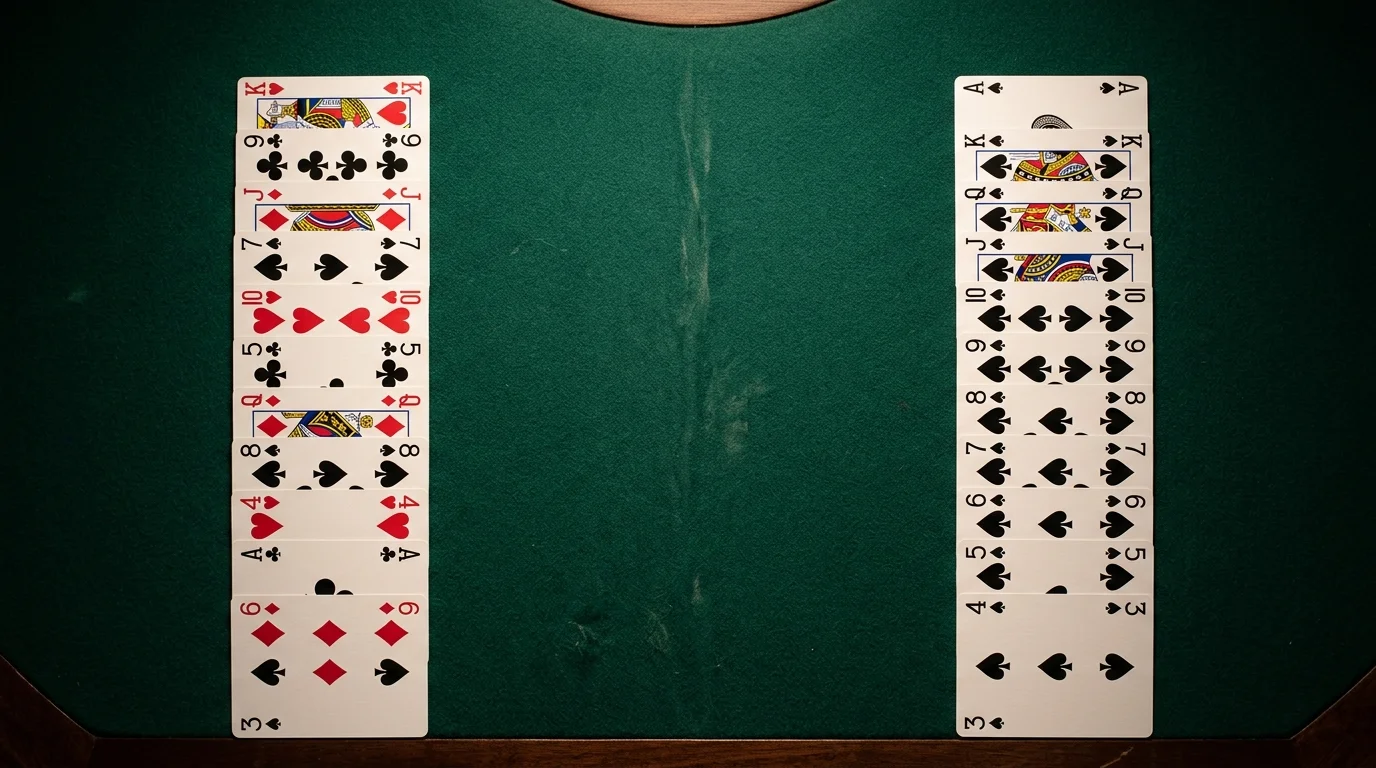
The division comes down to how you stack cards in the tableau. Yukon allows you to stack cards in alternating colors (red on black). Russian Solitaire strictly requires you to build descending sequences in the same suit (Spades on Spades, Hearts on Hearts).
Why Yukon is a High-Skill, Winable Challenge
Yukon is tough because it lacks a stockpile. However, the alternating-color rule gives you plenty of choices. Because you can stack a red card on a black card, you have multiple potential landing spots for your stacks.
A skilled player can win about 30% of their games. Success depends on exposing the face-down cards in the first four columns and using empty columns to store Kings. With patient planning, you can almost always find a path to clear the board.
Why Russian Solitaire is Extremely Difficult
Russian Solitaire is widely considered one of the hardest solitaire variations. Because you must stack cards in the same suit on the tableau, your movement options are incredibly restricted.
In Yukon, a black 7 has two landing spots: the two red 8s in the deck. In Russian Solitaire, a black 7 (say, the 7♠) has only one landing spot: the 8♠. If that specific card is buried face-down at the bottom of another column, your 7♠ is completely locked.
This strict rule makes it very easy to get blocked early in the game. Your win rate will drop to around 5% to 10%, even with perfect play. Winning requires extreme patience and a bit of luck with the initial deal.
Strategic Tips for Both Games
In Yukon:
- Clear Face-Down Cards First: Prioritize columns with face-down cards to unlock the hidden cards.
- Keep Workspaces Open: Avoid filling empty columns unless you need to park a King to expose a face-down card.
In Russian Solitaire:
- Expose the Aces Early: Since you must build by suit on the tableau, moving Aces directly to the foundations as soon as they appear is vital to free up space.
- Trace the Key Cards: Before making a move, look for the parent card of the same suit (e.g., if moving the 6♦, locate the 7♦ first). If the parent card is face-down, that move is a high priority.
- Free the Kings: You cannot win without empty columns to park Kings that block face-down cards. Plan your columns to free up space.