
Baker’s Game and FreeCell share almost identical layouts. Both deal all 52 cards face-up into eight columns, provide four temporary storage cells, and challenge you to build four foundations. Yet, one single rule modification separates them, turning a brutal puzzle into a satisfying, solvable strategic challenge.
Looking at the rules, history, and solvability of both games will help you choose the right variation for your skills.
Play Baker’s Game
100% Free. Play directly in your browser in full screen mode, no download or registration required.
Play Game NowThe Core Rule Difference
While both games look identical at first glance, the way you stack cards on the tableau is completely different.
| Game Mechanic | Baker’s Game | FreeCell Solitaire |
|---|---|---|
| Tableau Stacking | Built down by same suit (e.g., 6♠ on 7♠) | Built down by alternating colors (e.g., 6♦ on 7♠) |
| Open Cells | 4 temporary storage slots | 4 temporary storage slots |
| Empty Columns | Can hold any card | Can hold any card |
| Solvability Rate | ~75% of deals | 99.999% of deals (only 8 in 1 million unsolvable) |
| Difficulty Level | Hard / Restrictive | Medium / Strategic |
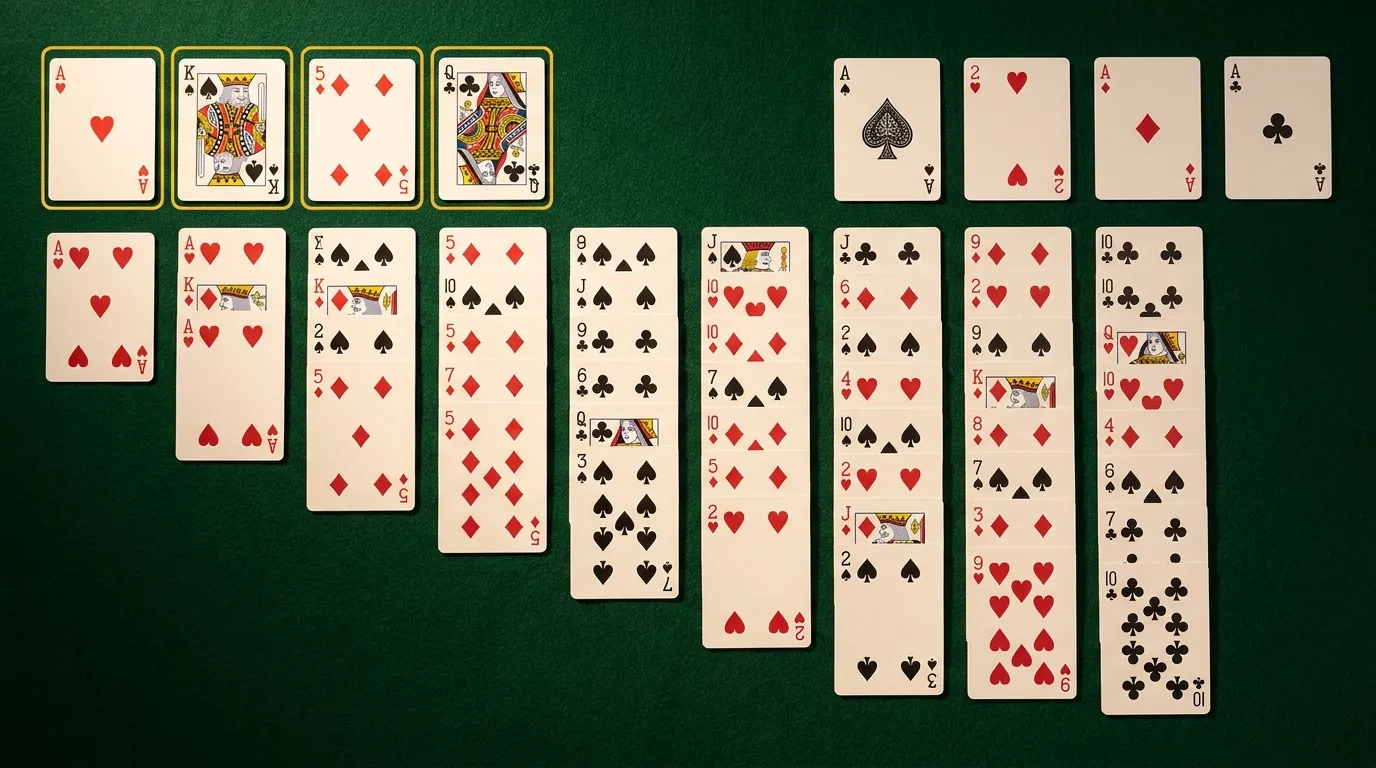
In FreeCell, you alternate colors when building columns. In Baker’s Game, you must build descending sequences in the exact same suit.
Because you cannot mix suits on the board, columns fill up with blocked cards much faster. This makes Baker’s Game significantly more restrictive and harder to solve.
The Historical Origin of Both Games
Baker’s Game is the direct predecessor of FreeCell. It was originally created by C. L. Baker in the mid-20th century, inspired by a game his father played. The game was popularized by Martin Gardner in his Mathematical Games column in Scientific American in 1968.
Years later, a programmer named Paul Alfille played Baker’s Game and found it frustratingly difficult due to the strict suit-matching rule. In 1978, he modified the rules to allow alternating colors on the tableau, creating FreeCell.
Alfille coded the first digital version of FreeCell, which eventually found its way into Microsoft Windows in the 1990s, turning it into a worldwide phenomenon while Baker’s Game remained a niche favorite.
Strategic Tips: Baker’s Game vs. FreeCell
Because the rules differ, your strategic approach must adjust:
Stacking in Baker’s Game: Use Free Cells Early
In Baker’s Game, you cannot stack opposite suits, so your four free cells are your only escape hatch. You must use them immediately to clear blockers. Because spaces are limited, try to move cards to the foundations as fast as possible to free up your board.
Stacking in FreeCell: Keep Free Cells Empty
In FreeCell, the alternating color rule allows you to build long runs on the tableau. You should avoid filling your free cells too early. Keep at least two cells empty to preserve your ability to move large sequences of cards between columns.
Empty Columns are King in Both Games
An empty column is always more powerful than a free cell because it can hold a sequence of cards rather than just a single card. Work to clear columns early in both games to give yourself maximum maneuvering space.
Which Version Should You Play?
- Play FreeCell if: You enjoy a satisfying logic puzzle where you know a solution almost always exists. FreeCell rewards long-term planning and yields a high win rate with smart play.
- Play Baker’s Game if: You find FreeCell too easy and want a challenging, restrictive puzzle that forces you to rely on tight card-by-suit sequencing.