
Spider Solitaire with two suits is the perfect middle ground for card game players. It offers more strategic depth than the simple single-suit version, without the punishing difficulty of the four-suit marathon. By limiting the game to two suits—typically Spades and Hearts—you get a highly solvable puzzle that still demands careful planning.
To win consistently, you need to learn how to keep your columns organised and avoid getting blocked by mixed-suit stacks.
Play Spider Solitaire 2 Suits
100% Free. Play directly in your browser in full screen mode, no download or registration required.
Play Game NowTwo-Suit Layout and Complexity
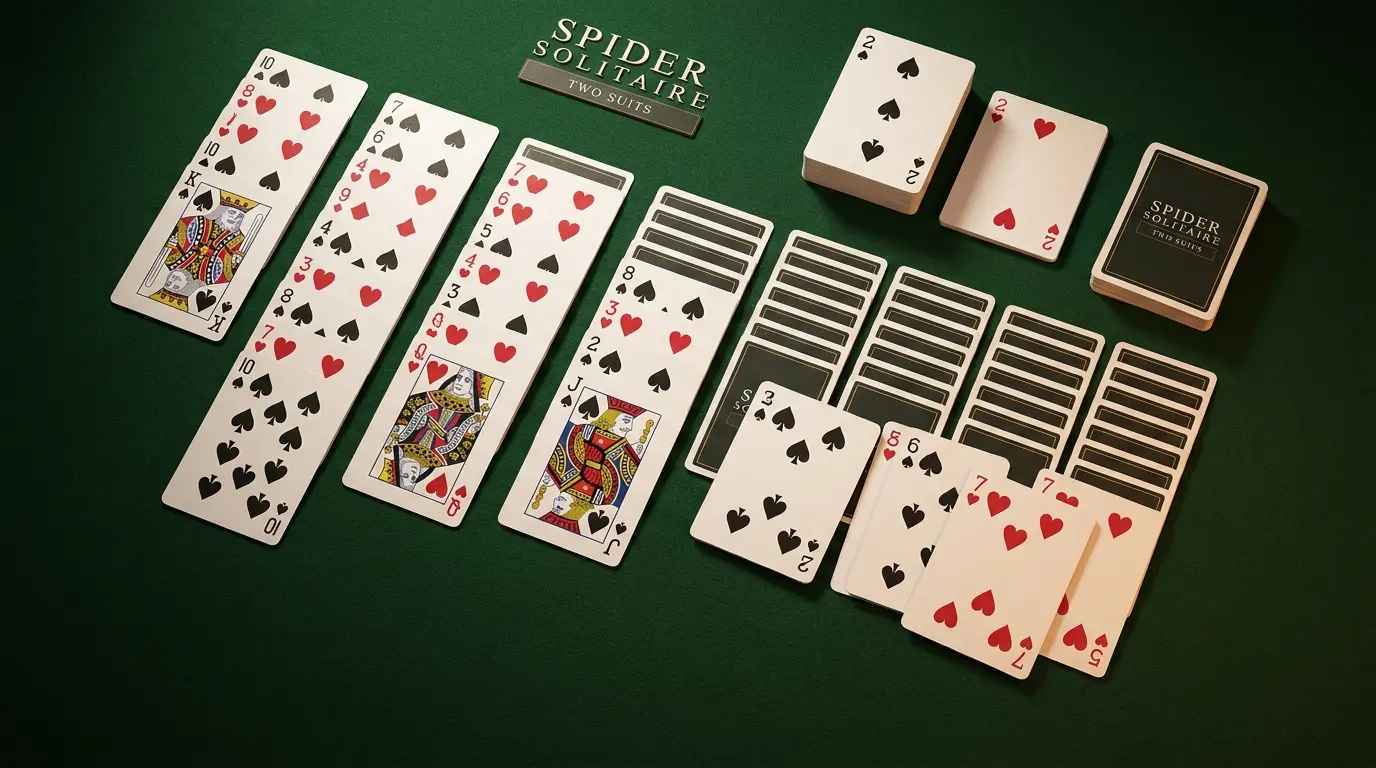
Understanding the card setup helps you evaluate your options before making moves on the board.
| Game Layout Metric | Specification |
|---|---|
| Total Cards | 104 cards (2 standard decks) |
| Active Suits | 2 suits (52 Spades and 52 Hearts) |
| Starting Board | 54 cards dealt face-down and face-up in 10 columns |
| Stock Pile | 50 cards remaining face-down for drawing rounds |
| Estimated Win Rate | 80% to 90% for skilled players using planning |
You can place a Spade on a Heart (or vice versa) if it is one rank lower. However, you can only move columns of cards as a single unit if they all belong to the same suit. Mixed columns block your movement, making them your biggest obstacle.
Core Tactics to Win at Two Suits
Apply these proven strategies to clean up your board and win almost every hand:
1. Build Same-Suit Runs by Default
Always prioritise placing cards of the same suit together. Even if a cross-suit move seems easy, it splits the column, meaning you cannot move those cards as a block. Keep Spades on Spades and Hearts on Hearts as much as possible to maintain maximum flexibility.
2. Clean Up Mixed Columns Before Dealing
Dealing from the stockpile places one card on every column, burying your organised sequences. Before you click the stock pile, look at the board and try to consolidate your cards. Shift mixed cards to create clean, single-suit sequences. Only deal when you have completely run out of moves.
3. Expose Hidden Cards in Shallow Columns
Focus your energy on columns with the fewest face-down cards. Clearing these columns gets you empty slots quickly. In two-suit play, empty columns are incredibly valuable sorting stations to separate Spades from Hearts.
4. Create “Sorting Columns”
Once you clear a column, do not immediately block it with a King unless you have a clear plan. Instead, use that empty column as a temporary workspace. Move cards back and forth to separate Spades and Hearts, building clean sequences in your other columns.
5. Expose Face-Down Cards Over Tableau Organisation
While keeping columns clean is important, your primary objective is revealing the 44 hidden cards. If you have to make a cross-suit move to reveal a face-down card, do it. The value of uncovering a hidden card is almost always worth the temporary mess.
6. Control the Placement of Kings
Kings are the end of the line. Once a King is in an empty column, you cannot move it unless you build a complete sequence to clear it. Only place a King in an empty column if you have enough cards of the same suit to build a significant portion of its sequence immediately.