
If you love Spider Solitaire but find the long two-deck deals exhausting, you are not alone. Many card game enthusiasts turn to Spiderette, a faster, single-deck cousin that packs the exact same sorting mechanics into a smaller layout. While they share core rules, the shift in deck size and board setup completely alters your tactical approach.
Comparing how these two variations match up will help you choose the right game for your schedule and skill level.
Play Spider Solitaire
100% Free. Play directly in your browser in full screen mode, no download or registration required.
Play Game NowComparing Rules and Setups
Both games require you to build descending sequences from King to Ace in the same suit to clear cards from the board. However, the scale of the game is very different:
| Game Mechanic | Spider Solitaire | Spiderette |
|---|---|---|
| Deck Count | 2 decks (104 cards) | 1 deck (52 cards) |
| Columns on Board | 10 columns | 7 columns |
| Initial Deal | 54 cards (some face-down) | 28 cards (Klondike-style setup) |
| Stock Pile Deal | Deals 10 cards at once | Deals 7 cards at once |
| Empty Columns | Can hold any card | Can hold any card |
| Play Duration | 15 to 30 minutes | 5 to 10 minutes |
| Average Solvability | ~15-20% (4 suits), ~90% (1 suit) | ~20% (strict play) |
Spider Solitaire is a massive undertaking. Dealing with 104 cards across ten columns makes it easy to run out of patience. You can stack cards of different suits on top of each other, but you can only move them together if they match in suit.
Spiderette uses a single 52-card deck dealt into a triangular, Klondike-style layout across seven columns. The columns increase in size from left to right, meaning you start with fewer face-down cards to clear, but you also have fewer columns to organize your stacks.
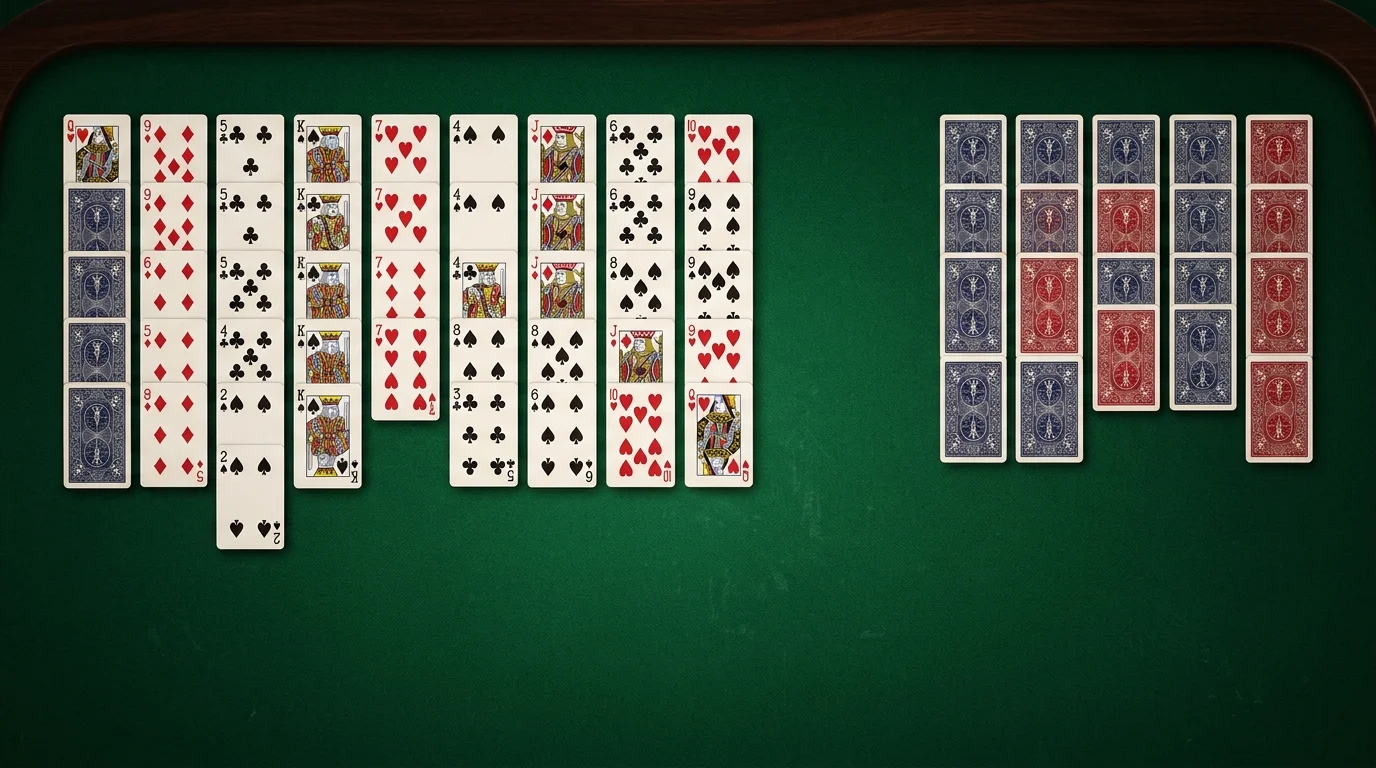
Spider Solitaire: The Double-Deck Endurance Test
Spider Solitaire is a marathon. Because you have ten columns, you have plenty of room to park cards and separate mixed-suit stacks.
However, the stockpile deals ten cards at once, creating a fresh layer of blockages across the entire board. Winning Spider Solitaire requires constant cleanup. You must build clean, single-suit runs to regain control of your board before dealing from the stock pile. The game rewards long-term planning and stamina.
Spiderette: The Fast and Crowded Sprint
Spiderette is a quick sprint. Since it uses only 52 cards, a game takes just a few minutes.
The challenge in Spiderette comes from the tight board. With only seven columns, you have very little room to maneuver. An empty column is incredibly difficult to create but is absolutely necessary to win.
Additionally, because the board is smaller, dealing cards from the stockpile (which deals seven cards at once, one onto each column) can instantly bury your active sequences. You must be aggressive about exposing face-down cards and creating empty columns early in the game to avoid getting completely blocked.
Tactical Strategy Adjustions
- Empty Columns: In Spider, clearing a column is a major milestone that gives you a massive workspace. In Spiderette, clearing a column is a survival requirement. You must prioritize clearing at least one column before your first stock deal.
- Managing Suits: In both games, try to keep your runs in the same suit. In Spiderette, because spaces are tight, even temporary cross-suit stacking should be avoided unless it directly exposes a face-down card.
- Tableau Cleanliness: Before clicking the stock pile for a new deal, spend time organizing cards to ensure as many runs as possible are in the same suit. Doing so makes it easier to untangle the board after the deal.
Which Variation Fits Your Style?
- Play Spider Solitaire if: You have 20 minutes to spare, enjoy large-scale planning, and want a deep, rewarding challenge that tests your patience.
- Play Spiderette if: You want a quick 5-minute session that offers the same satisfying suit-sorting logic as Spider, but in a compact, fast-paced format.